
Copy trading, step by step and cost by cost.
A strategy provider trades; your account repeats it. This site follows that machine from the first click to the last, lists every charge that can touch a copied trade, and says for each one whether a public page states its rate. Latest reading of the cTrader and CMA pages: 6 November 2026. It does not tell you whether to copy anyone.
Six pages, one machine
The path, step by step
Thirteen steps in the order the help pages give them, with the warning each one carries.
02What gets copied
The equity-to-equity formula, the cases in which a trade is skipped, and the ban on copying shares.
03Every cost in a copy
Seven charges, who receives each, and the page that states it, or the note that none does.
04Margin, leverage and stops
Maximum leverage printed by 24 brokers, the equity stop loss, and what a minimum investment locks.
05Money and the shilling
0 of 24 brokers print the shilling among their currencies; what moves inside a copy and what these pages do not cover.
06The CMA and foreign brokers
A register of 158 rows, a caution page of 15 names, and the CMA statement on copy trading that this site did not find.
What this site is, and the one thing it does
Copy Trade Kenya reads public pages about copy trading and writes down what they say, with the date each was read. The main source is cTrader Copy, the copy-trading service on the cTrader platform: its front page, its list of brokers, its three symbol pages and four of its help pages. The second source is the Capital Markets Authority of Kenya: its register of licensees, its caution page and its list of public notices. The latest reading was 6 November 2026.
The site is not a broker and does not hold money. It takes no side for or against copy trading and does not say whether anyone should copy anyone. Where a page was silent, this site says that it was silent instead of filling the gap.
The machine in one paragraph
A strategy provider trades on a live account. A follower, whom the help pages call an investor, allocates money to that strategy, and the platform opens a separate copy-trading account for it. From then on every trade of the provider is repeated on that account, sized by the ratio of the two equities. The follower can add or remove funds, set an equity stop loss, or stop, at which point the open positions are closed and the money goes back to the main account. The provider is paid by fees the platform takes from the follower's copy-trading account, and the platform keeps a share of those fees.
The path in thirteen steps
The first page walks the help pages in order: a cTrader ID, a hedging account, the membership type, the strategy list, the fee line on the Start copying button, the account and the amount, the confirmation, the opening of the provider's existing positions at current rates, the watching, the optional adding and removing of funds, the equity stop loss, and the stop or restart. Three warnings sit on that path: only hedging accounts can copy; lower leverage than the provider's can bring the stop out earlier; and every change of funds changes the sizes.
What the broker list showed
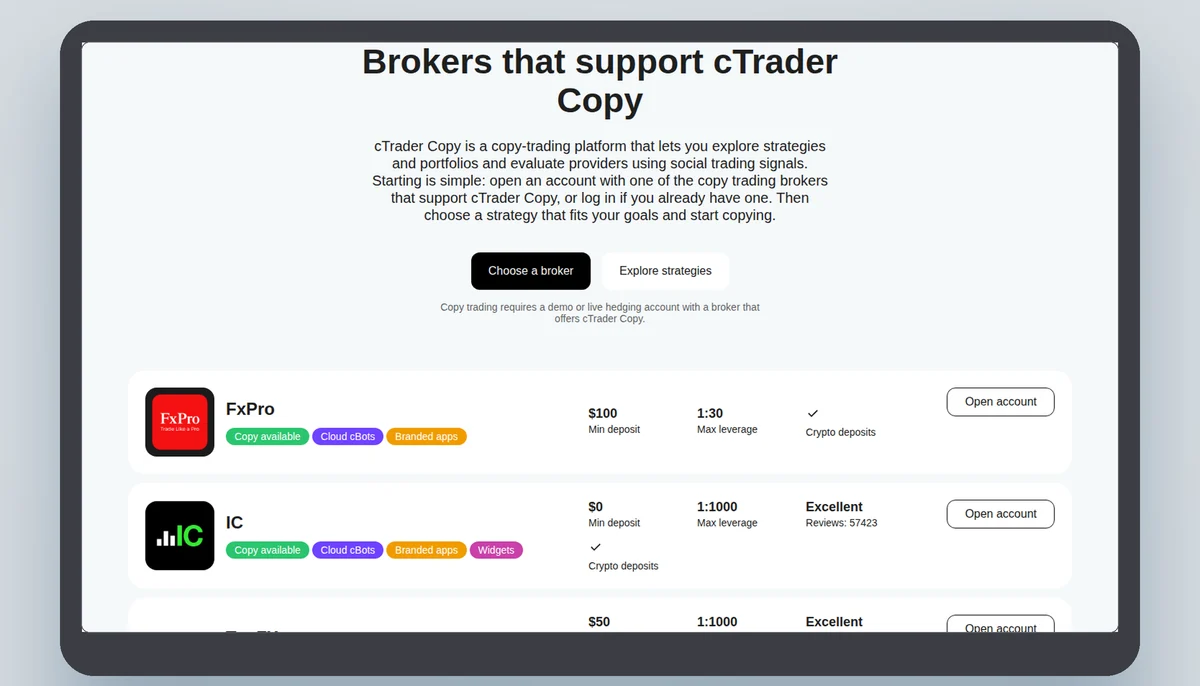
The page of brokers on ctrader.com held 53 broker entries on 6 November 2026, and 24 of them carried the copy flag that the page prints as "Copy available". Of those 24, 10 print no regulator at all and 1 prints the CMA of Kenya among its regulators. The printed maximum leverage ranges from 1:30 to 1:2,000; 18 print 1:500 or more. Minimum deposits run from USD 0 to USD 500. None lists the Kenyan shilling among its currencies. For FxPro, the broker this site links to, the list printed the copy flag, a maximum leverage of 1:30, a minimum deposit of USD 100 and the regulators "FCA UK; SCB - SIA Bahamas".
What the twenty strategy cards showed, in aggregate
cTrader's pages for gold, bitcoin and the euro show the same 20 strategy cards. Their ages on 6 November 2026 run from 49 days to 1,369 days: 4 are younger than 100 days, 8 are between 100 and 364 days, and 8 are a year old or more. 15 of the 20 include gold among their symbols, 11 trade a single symbol and one trades 10. Minimum investments run from USD 100 to USD 50,000. Next to each card a small curve of 29 daily points is drawn, from 8 October 2026 to 5 November 2026: 5 of the 20 ended below zero, and the deepest fall inside any curve is 36.79 points. Each card also prints a return whose period the cards do not state, and this site does not use it as a result for any reader. Nothing on this site is a ranking or a recommendation of any card, and none is named.
Every cost, in one list
Seven charges can touch a copied trade. The provider may charge a performance fee of up to 40% of net profit, a management fee of up to 10% of equity a year and a volume fee of up to USD 10 per million copied. The platform keeps 30% of those fees from 4 July 2026 without charging the investor more. The broker takes commission or spread, and may apply overnight financing, and money crossing between currencies or through a payment route carries charges of its own. The pages read state a rate for none of those last three. The costs page has the table and the help page's own worked example.
What the CMA lists showed
The register of licensees held 158 rows on 5 November 2026, in 9 categories; 14 are in a category named non-dealing-forex-broker and 3 in one named forex-money-manager. Those are the register's labels. The caution page dated 11 September 2026 named 15 firms. The page of public notices held 5 titles and none mentions copy trading. The list of press releases could not be read (HTTP 502). This site therefore states no position of the CMA on copy trading. It tells the reader how to check a firm on the register, and nothing more.
Why the follower's result is not the provider's
The platform says it itself: the provider's and the investor's prices may differ because of trading conditions and execution time. Beyond prices, the follower pays fees the provider's record does not include, the sizes are recalculated whenever either side adds or removes funds, trades can be skipped for lack of funds, margin or an instrument, and a follower with lower leverage can reach the stop out earlier. None of these has a figure on the pages read, so none has one here.
What the formula does to a small allocation
The help page's own example gives an investor with USD 1,000 a quarter of the provider's volume, because the provider's equity is USD 4,000. Keep the investor's USD 1,000 and make the provider's equity USD 100,000, the figure the page uses in its other example, and the ratio is 0.01: a provider position of 4 lots becomes 0.04 of a lot. Whether the investor's broker can open a position of that size is the case of the minimum trading volume on the exceptions list, where the size is adjusted to the step the broker allows. That is arithmetic on two figures taken from the page, not a description of a real account. It shows why the minimum investment on a card and the minimum volume of a broker are two numbers a reader needs side by side, and why the pages tell the reader to ask.
Where the sources end
Three things the pages read do not contain. The first is the fee of any one strategy, which is shown on a button inside the application. The second is the charge of the broker for a copied trade: spread, commission and overnight financing carry no rate on any page read. The third is everything between a Kenyan bank or mobile-money account and the broker, including the currency conversion, for which no page was read at all. The CMA lists add a fourth gap: they contain no statement about copy trading, and the list of press releases could not be opened. Each gap is marked where it falls, so that a reader can see which sentences rest on a page and which are questions.
How the six pages fit together
The path page gives the order of events and the warnings on it. The page on sizes gives the formula and the cases where a trade is skipped. The cost page gives the seven charges and when they are taken. The page on margin gives the floor under a copy: leverage, the stop loss and the minimum. The page on money separates what moves inside the platform from what moves outside it. The page on the Capital Markets Authority gives what its lists showed and what they did not. Read in that order they follow one copy from the first click to the last.
Questions to put to the broker before depositing
Is the copy service open to a resident of Kenya? Which company would hold the account, under which regulator, and is it on the CMA register? Is the account a hedging account? In which currency, and who converts shillings into it? Which ways of paying in and out are accepted from Kenya, and what does each cost? What do spread, commission and overnight financing come to on a copied position? What does the Start copying button show for the fees of the strategy in question? And what happens to the funds if the provider stops the strategy? The last one the help page answers: all investors stop copying, open positions are closed and unrealised fees are charged.
A short glossary
Provider: the trader whose positions are copied. Investor or follower: the account that repeats them. Copy-trading account: the separate account the platform opens for one strategy. Equity: the balance with open profit and loss included. High-water mark: the highest value reached, above which a performance fee is charged. Margin: the part of the account held back to keep leveraged positions open. Stop out: the broker closing positions because the margin no longer covers them. Contract for difference: a contract on a price, not ownership of the thing priced. Hedging account: an account that can hold opposite positions at once, the kind copying requires.
When the readings were taken
The cTrader pages were saved on 6 November 2026 within a few minutes of each other, one request at a time. The CMA register was read on 5 November 2026 and the caution and notice pages on 6 November 2026. A later reading may differ: brokers are added to the list, cards change, and a fee page can be revised. The date printed beside each figure is the only thing that makes it checkable, and a figure without its date is not published here.
How a figure on this site is checked
The pages are saved as read, and a second script counts the brokers, the cards, their dates and minimums, and the fall inside each curve from the saved files by a different route. A disagreement is reported as an error. The register recount agrees with the row counts stored when the pages were read. That checks the copying of the figures. It does not check that the platform's or the regulator's pages are right.
The broker this site links to
This site links to FxPro, which cTrader's list marks as a copy-enabled broker. A copied trade is a leveraged contract on a price, not ownership of anything. Whether the copy service is open to a resident of Kenya is a question for FxPro.