
What gets copied, and how big
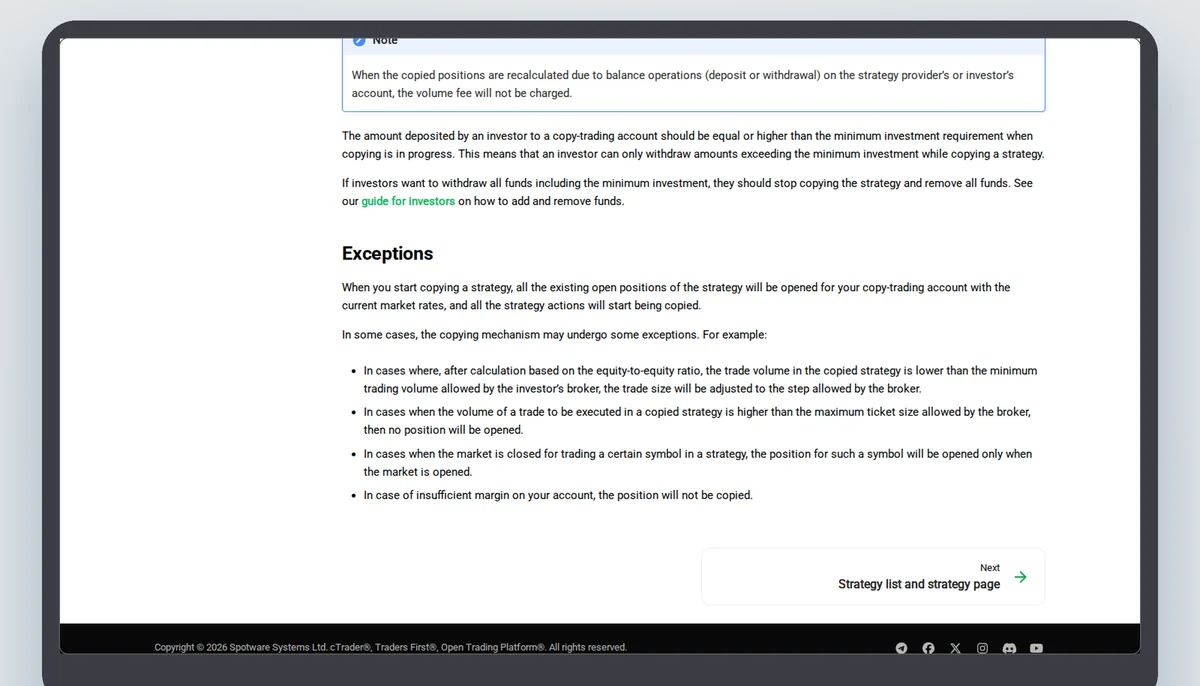
A copy is not a mirror of the provider's lots. Its size is computed from two balances, and the help page lists the cases in which it is not opened at all. This page sets out the formula and the cases as the introduction page of cTrader Copy gives them, read on 6 November 2026.
The formula
The introduction page defines the copied volume as the investor's equity, divided by the strategy provider's equity, multiplied by the provider's volume. Its example: the provider's equity is USD 4,000 and the investor's is USD 1,000; the provider opens 4 lots; the copy is 1,000 ÷ 4,000 × 4 = 1 lot. Equity here means the balance with open profit and loss included. The example's numbers were chosen by the page to show the arithmetic and say nothing about a real account.
The same formula with other investor equities
Arithmetic only: the provider's USD 4,000 and 4 lots are the page's; the investor equities in the first column are chosen here to show what the ratio does. They are not real accounts.
| Investor's equity (USD) | Working | Copied volume (lots) |
|---|---|---|
| 500 | 500 ÷ 4,000 × 4 | 0.5 |
| 1,000 | 1,000 ÷ 4,000 × 4 | 1 |
| 2,000 | 2,000 ÷ 4,000 × 4 | 2 |
| 4,000 | 4,000 ÷ 4,000 × 4 | 4 |
| 8,000 | 8,000 ÷ 4,000 × 4 | 8 |
When the balances move
The page says cTrader "automatically adjusts the volume of open positions and future trades based on both the provider's and investor's withdrawals or deposits". Its warning: depositing or withdrawing funds by the provider on the strategy account "with open positions can cause losses for investors' copy-trading accounts", because equity is recalculated each time the balance changes. The fees page puts the direction in a sentence: when the provider adds funds, the platform decreases the investors' positions, and when the provider withdraws, it increases them. The volume fee is not charged on those recalculations.
When a trade is not copied, or is resized
All rows are from the introduction page (help.ctrader.com/ctrader-copy), read on 6 November 2026. The page gives no order of precedence among them.
| Case | What the page says happens | Page section |
|---|---|---|
| Not enough funds in the investor's account | The provider's trade is not copied. | Introduction |
| The investor's broker lacks the instrument | The provider's trade is not copied. | Introduction |
| The investor's leverage is lower and free margin may not suffice | Not all trades of the strategy may be copied. | Introduction |
| The calculated volume is below the broker's minimum | The size is adjusted to the step the broker allows. | Introduction |
| The volume is above the broker's maximum ticket size | No position is opened. | Introduction |
| The market for the symbol is closed | The position is opened only when the market opens. | Introduction |
| The margin on the account is insufficient | The position is not copied. | Introduction |
| The symbol represents a stock or a share | Not copied at all; the provider may trade it. | Introduction |
Shares are never copied
The introduction page carries a warning: "cTrader Copy forbids copying any trades made for symbols representing stocks and shares." A provider can still open such positions, and the page names AAPL and TSLA, but the investors do not copy them. So a copy never gives a position in a share, local or foreign. What is copied is a contract on the price of an instrument the broker offers as such.
Prices are not identical
The same page warns that "the provider's and investor's prices may differ due to variations in trading conditions and execution time". No public page this site read measures that gap. It is a reason why the follower's result and the provider's printed record are two different documents, and the question of fees is on another page.
What the twenty strategy cards add
The 20 cards on cTrader's symbol pages list the symbols each strategy trades. 15 of the 20 include gold (XAUUSD), 11 trade a single symbol, 3 trade four or more, and the longest list has 10 symbols. The strategy-page help says: "When choosing a strategy to copy, check whether the strategy provider is trading the same symbols as those that are available from your broker." A card whose symbols the broker lacks falls under the second case in the table above. The card itself does not say which brokers offer which of its symbols.
In brief
Read next
Questions about the machine and its costs
Does the follower always hold the provider's positions?
No. The introduction page lists cases in which a position is skipped, resized or delayed, so a follower can hold fewer positions than the provider.
What does the ratio do for a small account?
It scales every position down in proportion. The page's example turns 4 lots into 1; the table above shows other ratios. Adjustment to the broker's step is the case where the scaled size is too small.
Can a share be copied if the provider trades one?
No. The page forbids copying stock and share symbols.
Is the price I get the provider's price?
Not necessarily; the page says the two sides' prices may differ because of trading conditions and execution time.
The broker this site links to
This site links to FxPro, which cTrader's list marks as a copy-enabled broker. A copied trade is a leveraged contract on a price, not ownership of anything. Whether the copy service is open to a resident of Kenya is a question for FxPro.